Make it walk in MuJoCo
The tutorial ends with a URDF. This page takes the same quadruped into MuJoCo and trains it to walk with reinforcement learning, on a CPU, in under an hour.
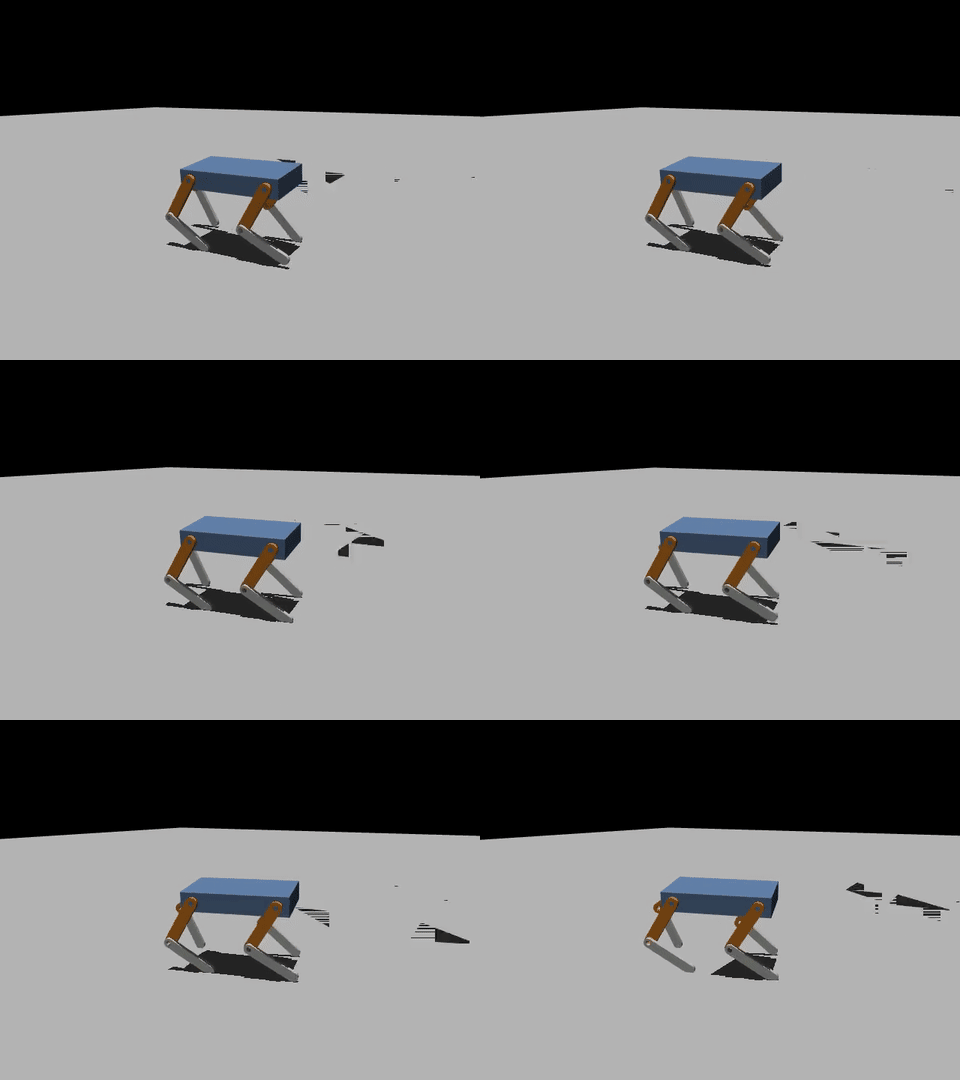
The trainer is not part of sw2robot. It is the CPU trainer of the book
つくりながら学ぶ!リアルタイムOS自作入門:
code/13_quadruped/rl/cpu
in iory/build-your-own-arduino-rtos.
It trains the book's own 8-servo quadruped, which has the same layout as ours
(a hip and a knee per leg, both pitching), so the robot only has to be
described the way that trainer expects. sw2robot's editor does almost all of
that.
| You need | the examples/quadruped package (or your own from the tutorial), Linux or WSL 2, uv |
| Training | ArduinoQuad-Walk, PPO (rsl-rl), 2048 robots in parallel on the CPU |
| Measured | 1200 iterations in 52 min on 12 CPU threads (WSL 2) |
1. Name the robot the way the trainer expects
The trainer finds everything by name, and checks the joint order. Open the
package in the editor (sw2robot-web examples/quadruped) and:
-
= rename the joints and links:
CAD joint link front left ( thigh_1,shin_1)FL_hip_joint,FL_knee_jointFL_thigh,FLrear left ( thigh_3,shin_3)RL_hip_joint,RL_knee_jointRL_thigh,RLrear right ( thigh_4,shin_4)RR_hip_joint,RR_knee_jointRR_thigh,RRfront right ( thigh_2,shin_2)FR_hip_joint,FR_knee_jointFR_thigh,FRName each lower leg after its leg (
FL, notFL_shin). The MuJoCo export names the foot's contact sphere<link>_toeand its site<link>, and the trainer looks forFL_toeand a site calledFL. -
Select each right knee and press
f, so every joint turns the same way (as in the tutorial, step 4). -
In each joint's Actuator & physics, set effort 2.942 N·m and velocity 4.717 rad/s: the Feetech STS3215 (12 V) servo the trainer's motor model is built around. Hip limits ±1.57, knee ±2.5.
-
Joint order. The trainer expects the legs in the order FL, RL, RR, FR, hip before knee. The editor has no control for this; the order of the
joints:list inquadruped.joints.yamldecides it, so put the entries in that order by hand:joints: - parent: body_1 # FL hip child: thigh_1 type: revolute # ... keep its limits / effort / velocity / flip_axis lines - parent: thigh_1 # FL knee child: shin_1 type: revolute # ... keep its limits / effort / velocity / flip_axis lines - parent: body_1 # RL hip child: thigh_3 type: revolute # ... keep its limits / effort / velocity / flip_axis lines - parent: thigh_3 # RL knee child: shin_3 type: revolute # ... keep its limits / effort / velocity / flip_axis lines - parent: body_1 # RR hip child: thigh_4 type: revolute # ... keep its limits / effort / velocity / flip_axis lines - parent: thigh_4 # RR knee child: shin_4 type: revolute # ... keep its limits / effort / velocity / flip_axis lines - parent: body_1 # FR hip child: thigh_2 type: revolute # ... keep its limits / effort / velocity / flip_axis lines - parent: thigh_2 # FR knee child: shin_2 type: revolute # ... keep its limits / effort / velocity / flip_axis lines(Keep each entry's limits,
effort,velocityandflip_axisfrom the steps above.) Reopen the package in the editor afterwards.
2. Export the MJCF
Click ⬇ MuJoCo (MJCF) in the editor's Export panel, or from the command line:
python -m sw2robot.exporter.build examples/quadruped \
    --config examples/quadruped/quadruped.joints.yaml --mujoco
The quadruped_mjcf package holds mjcf/quadruped.xml: a floating base, the
eight joints, a contact sphere FL_toe … and a site FL … on each foot, and
an IMU site with the imu_* and root_angmom sensors the trainer reads. Its
own actuators and keyframe are replaced by the trainer's.
3. Point the trainer at it
git clone https://github.com/iory/build-your-own-arduino-rtos
cd build-your-own-arduino-rtos/code/13_quadruped/rl/cpu
One thing in task.py belongs to the book's robot: the standing pose, a table
from base height to (hip, knee) angles. For this robot, with each toe under its
hip, knee = -2 * hip and height = 0.2 * cos(hip) + 0.01. Replace the table
and its default:
HOME_TABLE = {  # the sw2robot tutorial quadruped
    0.13: (0.9273, -1.8546),
    0.14: (0.8632, -1.7264),
    0.15: (0.7954, -1.5908),
    0.16: (0.7227, -1.4455),
    0.17: (0.6435, -1.2870),
}
HOME_BASE_HEIGHT = round(_f("ARDUINO_QUAD_HOME_HEIGHT", "0.15"), 2)
No GPU?
uv sync installs PyTorch's default Linux build, which pulls in the CUDA
libraries (several GB). Training runs entirely on the CPU, so the CPU
build is enough: add this to pyproject.toml before uv sync.
[tool.uv.sources]
torch = [{ index = "pytorch-cpu" }]

[[tool.uv.index]]
name = "pytorch-cpu"
url = "https://download.pytorch.org/whl/cpu"
explicit = true
4. Train
uv sync
export ARDUINO_QUAD_XML=/path/to/quadruped_mjcf/mjcf/quadruped.xml
export ARDUINO_QUAD_HOME_HEIGHT=0.15 ARDUINO_QUAD_GAIT_PERIOD=0.32
uv run train.py --num-envs 2048 --iterations 1200 --seed 1
Within the first few hundred iterations the robots stop falling over (episode length reaches its 1000-step maximum); forward walking follows once the command curriculum widens at iteration 600.
5. Watch it walk
MUJOCO_GL=egl uv run evaluate.py \
    --checkpoint logs/rsl_rl/arduino_quad_velocity/<run>/model_1200.pt --video walk.mp4
evaluate.py drives 64 robots for 20 s per command and reports how fast they
go. Measured on the policy above:
| command (forward m/s, turn rad/s) | forward | turn | falls (of 64) |
|---|---|---|---|
| 0.06, 0 | 0.079 | 0.015 | 0 |
| 0.09, 0 | 0.109 | 0.041 | 0 |
| 0.12, 0 | 0.118 | 0.028 | 0 |
| 0, 0.3 | −0.001 | 0.172 | 0 |
| 0.06, −0.3 | 0.062 | −0.114 | 0 |
With --dr (the masses, friction and servo gains randomized as in training)
it still walks with no falls, 0.089 m/s at the 0.09 command.
It follows forward commands and never falls, but it is not a polished gait yet:
- Turning reaches about half the command (0.17 of 0.3 rad/s), and walking straight it drifts slightly to the left.
- The feet slip 55–68 mm/s on the ground. The body is a solid ABS block (1.08 kg) on 40 g legs and small round feet; hollowing out the body, or giving the feet a larger contact sphere, are the first things to try.
- Training longer helps: 2300 iterations (about 100 min) tightened the turning and the straight-line drift on an earlier run of the same robot (with a hand-made MJCF whose toe spheres were 10 mm instead of the export's 4 mm).